
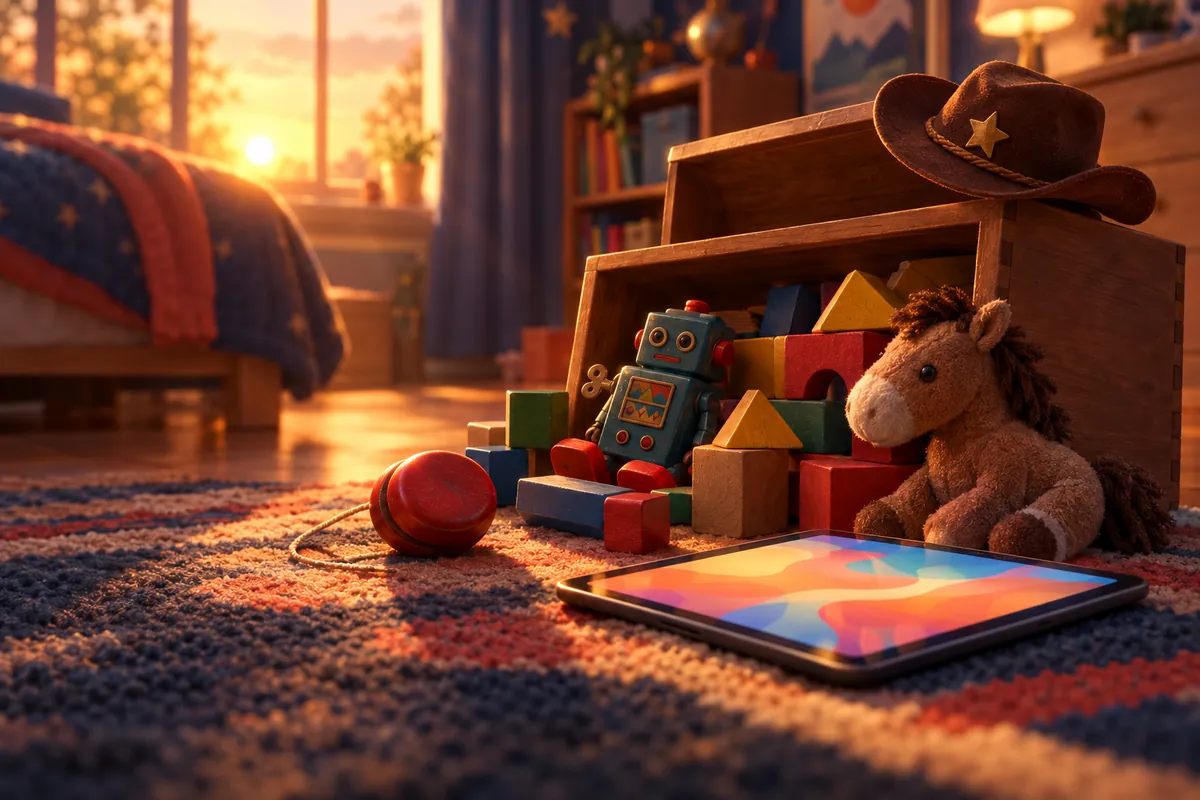
Film: Toy Story 5 (Disney / Pixar) · Spotlight character: Sheriff Jessie · Core themes: Screen time, real connection & self-discovery
Walking into the fifth installment of a thirty-year-old franchise, it is only natural to wonder if there is any story left to tell. Yet Toy Story 5 accomplishes the seemingly impossible: it delivers a remarkably fresh, deeply relevant narrative that justifies reopening the toy box once again. Instead of simply retreading the familiar territory of children outgrowing their playthings, Pixar pivots to the most pressing existential shift facing childhood today: the transition from imaginative play to growing up around screens.
Jessie takes the spotlight
At the heart of this evolution is Sheriff Jessie, who rightfully steps into the spotlight as the emotional anchor of the film. Bearing the badge as the leader of Bonnie’s room, Jessie is forced to navigate a rapidly changing landscape when a tablet named Lilypad captures Bonnie’s attention. Watching the brave cowgirl search for meaning, relevance, and her own place in a digital world gives the movie its soul. Joan Cusack brings an earnest vulnerability to Jessie’s journey as she wrestles with the fear of being replaced not by a shinier action figure, but by an entire digital ecosystem.
Rather than waging an all-out war against screens, Jessie learns to accept technology’s place in a child’s life while fiercely advocating for the tangible, irreplaceable connections that only real-world play and presence can foster.
Not a “screens are bad” movie
What elevates the film from a fun animated adventure to a poignant cultural commentary is its refusal to take a simplistic “technology is bad” stance. The story thoughtfully examines the real-world struggles kids face today in forging genuine human connections, while offering a sympathetic nod to the modern parental dilemma of knowing when, and how, to introduce screen time. It doesn’t shy away from the darker corners of the online world, courageously touching on heavy realities like cyberbullying and digital isolation. Yet the screenplay is smart enough to recognize that completely rejecting technology is neither plausible nor feasible in the modern era.
Through Jessie’s eyes, the film arrives at a mature, balanced truth. Rather than waging an all-out war against screens, Jessie learns to accept technology’s place in a child’s life while fiercely advocating for the tangible, irreplaceable connections that only real-world play and presence can foster. Some of the story’s best moments come from seeing the traditional toys and digital devices find common ground, proving that friends, and allies, can be found where you least expect them.
The takeaway
Ultimately, Toy Story 5 is a triumph of self-discovery, empathy, and connection. It reminds us that whether through a pull-string cowgirl or a glowing tablet, the true goal of childhood remains the same: helping kids find genuine friendship and build lasting memories in an ever-changing world.
What I loved
- A fresh franchise direction: tackles the modern shift toward screen-based childhoods without feeling repetitive.
- A nuanced perspective on tech: addresses real dangers like cyberbullying and parental screen-time dilemmas while acknowledging technology as an unavoidable part of modern life.
- Sheriff Jessie at the center: an emotional arc of self-discovery as Jessie bridges the gap between digital entertainment and real-world human connection.